 Medical Director Services
 MSO-PC Framework (CPOM Structuring)
 Compliance Auditing & Solutions
 Telehealth Expansion
 Good Faith Exams (GFEs)
 Business Operations Consulting
 Strategic Growth and Services Expansion Support
 Contract Negotiation (GPO Alternative)
 Medical Aesthetic Clinics (Med Spas)
 Wellness, Weight Loss, & Functional Medicine Clinics
 Telehealth Companies
New Jersey Med Spa Laws: Key Regulations to Know in 2026
New Jersey is not the state where you want to find out you were doing it wrong.
There are clinics in the Garden State where the business model is functionally illegal – not because the owners are bad actors, but because they built their practices on assumptions that do not survive contact with N.J.S.A. 45:9-2. They assumed that because a service is cosmetic, it is not medical. They assumed a medical director’s signature on a contract was the same as clinical oversight. They assumed their aesthetician could administer neurotoxins because she had a certification and five years of experience. Every one of those assumptions is a compliance failure under New Jersey law.
And in early 2026, the regulatory floor just got higher. The New Jersey Board of Medical Examiners and the Board of Pharmacy published a joint rule proposal in February 2026 that further tightens oversight of injectable administration, compounding, and telehealth prescribing. The public comment period closes May 5, 2026. If you operate a med spa in New Jersey – or plan to – this is the guide that tells you exactly where the lines are and what happens when you cross them.
What This Guide Covers
- New Jersey’s Corporate Practice of Medicine Doctrine
- Medical Director Requirements
- Scope of Practice: Who Can Do What
- The Aesthetician Line – Where Cosmetology Ends and Medicine Begins
- Office Surgery and Special Procedure Rules (N.J.A.C. 13:35-4A)
- Telehealth and Telemedicine Regulations
- What Changed in 2026
- Structuring Your NJ Med Spa: The MSO-PC Framework
- Enforcement and Penalties
- Frequently Asked Questions
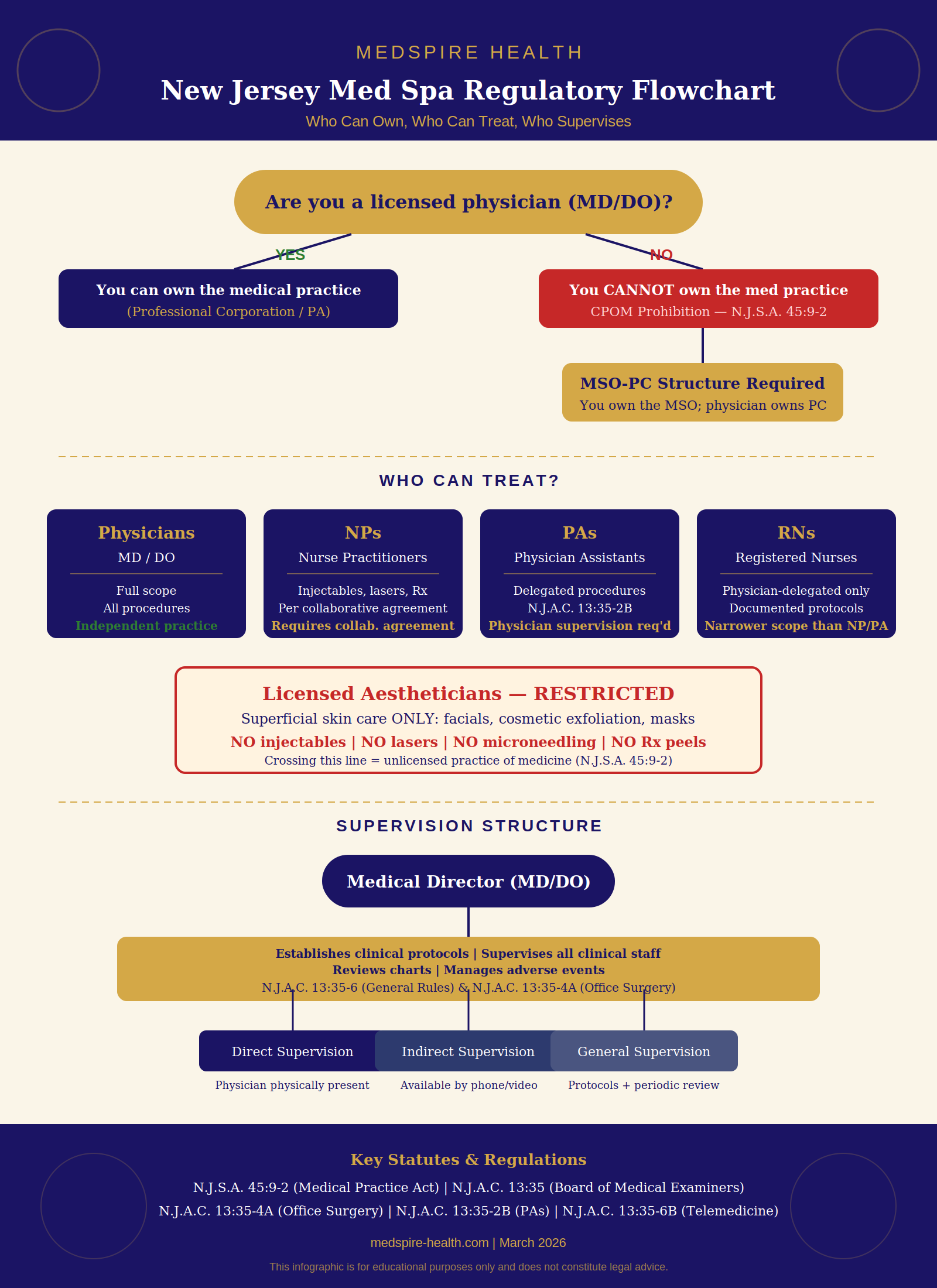
New Jersey’s Corporate Practice of Medicine Doctrine
New Jersey prohibits the corporate practice of medicine.
Under N.J.S.A. 45:9-2, the practice of medicine is limited to individuals licensed by the New Jersey Board of Medical Examiners. That statute does not contain a carve-out for aesthetic procedures. It does not distinguish between a dermatology clinic and a med spa that offers Botox and laser hair removal. If the treatment involves a medical act – and in New Jersey, injectables, laser procedures, microneedling, prescription chemical peels, and IV therapy are all classified as medical acts – the practice must be owned and controlled by a licensed physician.
This is where non-physician entrepreneurs run into the wall. You cannot form an LLC, hire a nurse practitioner, and call it a med spa. Not in New Jersey. The entity that delivers medical services must be a professional corporation or professional association owned by a licensed physician. The clinical decisions (e.g., which procedures to offer, what protocols to follow, who administers what) must rest with a physician. Not an operations manager. Not a business partner. A physician.
I have seen founders try to work around this with creative interpretations: “I own the building, and the doctor owns the practice.” Maybe. But if your management agreement gives you de facto control over clinical operations – hiring and firing clinical staff, setting treatment menus, controlling scheduling – you have likely crossed from business management into the practice of medicine. And the Board will read through the paperwork to find out.
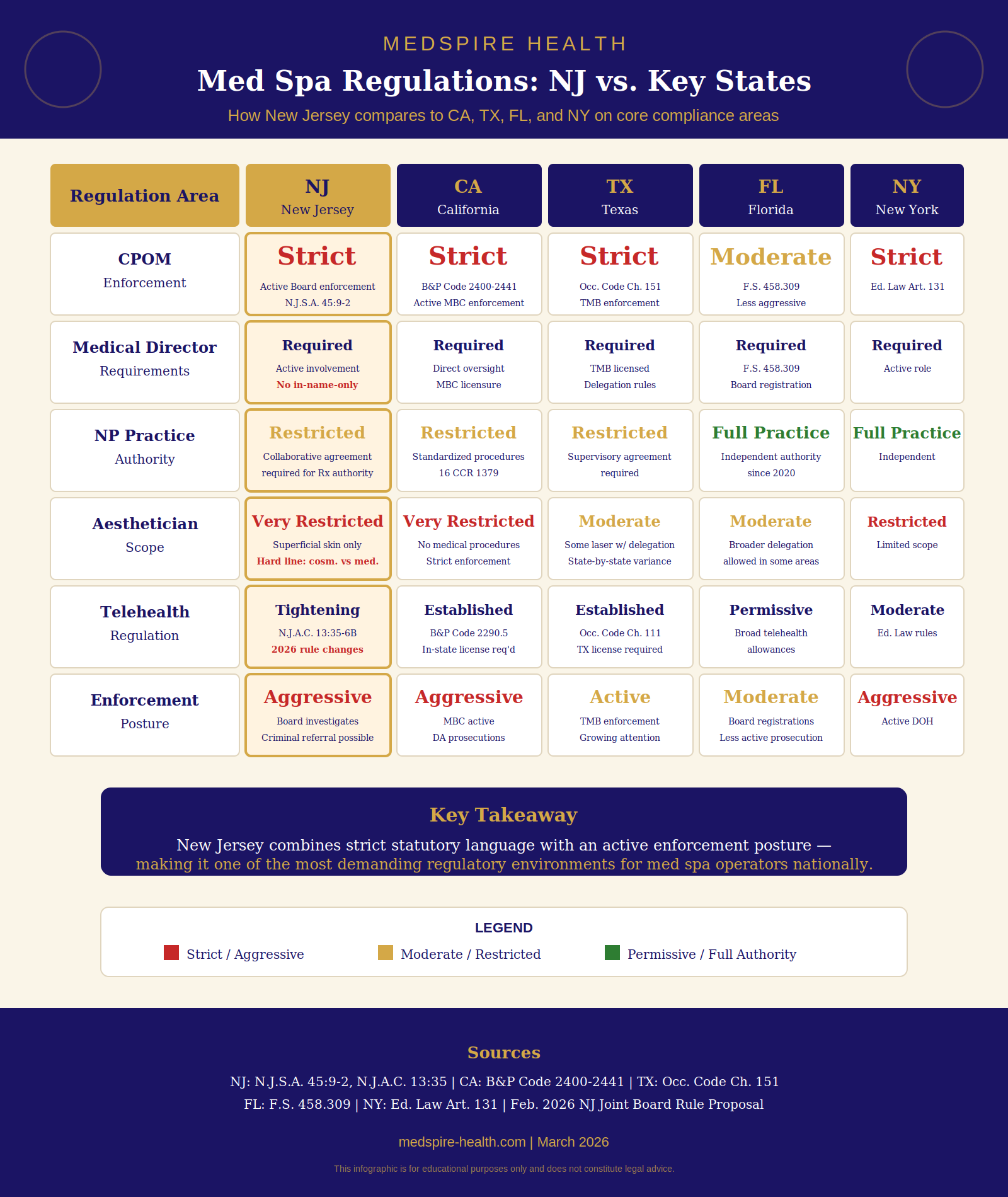
How NJ Compares to Other Strict CPOM States
New Jersey’s CPOM enforcement sits in the top tier nationally, alongside California (Business and Professions Code §§ 2400–2441), Texas (Occupations Code Chapter 151), New York, and Illinois. But NJ has a distinctive enforcement posture: it combines strict statutory language with a Board of Medical Examiners that has historically been willing to investigate and act. In states with strict laws but passive enforcement, operators sometimes get comfortable. New Jersey is not that state.
Medical Director Requirements
Every med spa operating in New Jersey must have a medical director who is a physician licensed by the New Jersey Board of Medical Examiners. This is a legal requirement, not an operational suggestion.
Under N.J.A.C. 13:35-6 (General Rules of Practice) and N.J.A.C. 13:35-4A (Office Surgery and Special Procedures), the medical director is responsible for establishing and approving all clinical protocols, directly or indirectly supervising all clinical staff performing medical procedures, conducting ongoing chart reviews and quality assurance, maintaining documented emergency protocols and adverse event procedures, and ensuring all providers operate within their scope of practice under New Jersey law.
The critical word is “active.” New Jersey does not accept paper-only medical directors. If your medical director’s involvement consists of a signature on a contract and a monthly wire transfer, you are not in compliance. You are running an illegal operation with a doctor’s name on it. The Board knows what this looks like. They have investigated it. They will investigate it again. Learn more about what active medical director oversight looks like in practice, and how MedSpire structures it.
Supervision Levels in New Jersey
New Jersey defines supervision requirements for mid-level providers through specific regulatory subchapters. Under N.J.A.C. 13:35-2B, physician assistants must practice under the supervision of a licensed physician, with the degree of supervision – direct, indirect, or chart review – determined by the delegated task and documented in a supervision agreement. The supervising physician must be available for consultation when the PA is providing patient care.
Nurse practitioners in New Jersey operate under the State Board of Nursing, with collaborative practice agreements required for prescriptive authority. For med spa settings, the intersection of Board of Medical Examiners rules and Board of Nursing rules means your NP’s scope is defined by both the nursing practice act and the protocols your medical director establishes. If those two sources conflict, the more restrictive standard applies.
Scope of Practice: Who Can Do What
Scope of practice is where most NJ med spa compliance failures actually live. Not in the corporate structure. Not in the paperwork. In the treatment room, where someone is performing a procedure they are not legally authorized to perform.
Physicians (MD/DO): Full scope. Can perform all medical aesthetic procedures and supervise all other clinical providers.
Nurse Practitioners (NPs): Can perform medical aesthetic procedures within their collaborative practice agreement and the protocols established by the medical director. NPs in NJ require a collaborative agreement for prescriptive authority. Injectable administration, laser treatments, and other medical aesthetic procedures fall within NP scope when properly delegated and supervised.
Physician Assistants (PAs): Practice under physician supervision per N.J.A.C. 13:35-2B. Can perform delegated medical procedures including injectables and laser treatments, but the supervising physician must define the scope and supervision level in a written agreement. The physician must be available for consultation during patient care.
Registered Nurses (RNs): Can administer medical aesthetic treatments – including injectables – when delegated by a physician and operating under established protocols. The RN scope is narrower than NPs and PAs, and delegation must be documented.
Licensed Aestheticians: This is where the line gets hard, and where most violations occur. (See the next section.)
The Aesthetician Line – Where Cosmetology Ends and Medicine Begins
If you operate a med spa in New Jersey and you employ aestheticians, this section is the one that keeps you out of trouble or puts you in it.
The New Jersey Board of Medical Examiners draws a hard regulatory line between cosmetology and medicine. Licensed aestheticians are confined to superficial skin care services: facials, cosmetic-grade exfoliation, non-medical masks, and topical cosmetic application. They cannot administer injectables. They cannot operate medical-grade lasers. They cannot perform microneedling. They cannot administer prescription-strength chemical peels. Any procedure that penetrates beyond the epidermis or involves a prescription product is a medical act under N.J.S.A. 45:9-2, and performing it without a medical license constitutes the unlicensed practice of medicine.
This is not a grey area. The Board has made it explicit. And yet I routinely encounter NJ med spas where aestheticians are doing exactly this – usually because the owner assumed a certification from a device manufacturer or a continuing education course was equivalent to a medical license. It is not. A laser manufacturer’s training certificate does not override state law. A weekend injectable course does not expand your scope of practice. Only the statutes and your licensing board define what you can do. Everything else is marketing.
The penalty for getting this wrong is not a slap on the wrist. The aesthetician faces criminal exposure for unlicensed practice. The medical director faces license jeopardy for inadequate supervision. The practice owner faces forced closure. Everyone loses – and the patient who trusted your clinic absorbed the risk of a procedure performed by someone who was never authorized to do it.
Office Surgery and Special Procedure Rules (N.J.A.C. 13:35-4A)
N.J.A.C. 13:35-4A governs office-based surgery and special procedures in New Jersey. For med spas, this subchapter is directly relevant if your treatment menu includes anything beyond the most superficial cosmetic services.
The regulation establishes requirements for the physical facility (equipment, emergency supplies, monitoring capabilities), the qualifications of personnel performing and assisting with procedures, informed consent and documentation standards, and protocols for managing adverse events and emergencies. If your practice performs any procedure that involves sedation, penetration below the dermis, or carries risk of significant adverse reaction, N.J.A.C. 13:35-4A applies to you. This includes many common med spa treatments: certain laser procedures, deep chemical peels, and any procedure involving moderate or greater sedation.
Compliance with 4A is not optional even if you consider your practice “cosmetic.” New Jersey does not distinguish between a surgical center and a med spa when it comes to patient safety standards for invasive or quasi-invasive procedures. If the procedure carries medical risk, the regulation applies regardless of the setting.
Telehealth and Telemedicine Regulations
Telehealth has become a significant component of the med spa business model – particularly for weight loss programs (GLP-1 prescribing), hormone replacement therapy (HRT and TRT), and initial consultations. New Jersey regulates telehealth through N.J.A.C. 13:35-6B (Telemedicine for physicians) and N.J.A.C. 13:35-2C (Telehealth for physician assistants), both of which were included in the January 2025 re-adoption of N.J.A.C. 13:35.
Under these regulations, a telemedicine encounter in New Jersey must meet the same standard of care as an in-person visit. The provider must be licensed in New Jersey. The initial patient evaluation may be conducted via telemedicine, but the provider must use clinical judgment to determine whether an in-person visit is necessary before prescribing treatment. Prescribing controlled substances via telemedicine is subject to additional restrictions under both state and federal DEA regulations.
For med spas offering telehealth consultations or prescribing weight loss medications remotely, the compliance requirements are layered: the prescribing provider must hold a New Jersey license, the telemedicine platform must comply with HIPAA, the encounter must be documented to the same standard as an in-person visit, and the prescribing must follow state prescribing guidelines – which, as of the February 2026 rule proposal, are under active revision.
If you are building a telehealth component into your NJ med spa practice, do not assume your current protocols are compliant. The rules are moving. We cover telehealth compliance in detail in our Telehealth Compliance services.
What Changed in 2026
Two regulatory developments in early 2026 have shifted the compliance landscape for NJ med spas.
N.J.A.C. 13:35 Readoption (January 2025, Effective Through 2026)
The full body of Board of Medical Examiners regulations – N.J.A.C. 13:35 – was re-adopted on January 8, 2025, under the authority of N.J.S.A. 45:9-2. This re-adoption updated and reaffirmed every subchapter relevant to med spa operations, including Subchapter 2B (Physician Assistants), Subchapter 4A (Office Surgery and Special Procedures), Subchapter 6 (General Rules of Practice), Subchapter 6B (Telemedicine), and Subchapter 2C (Telehealth: Physician Assistants). Re-adoption means these are the current, enforceable standards. If your compliance framework predates January 2025, it may reference superseded provisions.
Joint Board of Medical Examiners / Board of Pharmacy Rule Proposal (February 2026)
On February 12, 2026, the Board of Medical Examiners and Board of Pharmacy published a joint rule proposal targeting several areas that directly affect med spa operations: oversight of prescription compounding and dispensing within aesthetic practices, injectable administration protocols and documentation requirements, and telehealth prescribing standards – particularly for weight management and hormone therapy programs.
The public comment period for this proposal closes May 5, 2026. If these rules are adopted as proposed, they will tighten existing requirements and create new compliance obligations for med spa operators. This is not the time to wait and see. If you are operating a med spa in NJ, you need to understand what is being proposed, assess whether your current operations comply, and submit comments if the rules would affect your practice. We can help with that assessment – schedule a consultation before the comment period closes.
New Jersey Senate Bill 2996 (Signed March 30, 2026)
On March 30, 2026, Governor Mikie Sherrill signed Senate Bill 2996 into law, expanding practice autonomy for advanced practice nurses (APNs) in New Jersey. The law eliminates the joint protocol agreement requirement for APNs who have completed at least 5,000 hours of licensed, active advanced nursing practice — but only for APNs providing primary or behavioral health care as defined in the statute.
For med spa operators, the critical detail is what the law does not change. The legislation explicitly carves out APNs providing elective aesthetic or cosmetic services, who are still required to maintain a joint protocol agreement with a collaborating physician.
This means the collaborative oversight requirements described in this guide remain in effect for aesthetic and cosmetic practice settings. An APN working in a med spa cannot rely on SB 2996 to operate without physician collaboration. The same protocols, supervision agreements, and medical director involvement apply.
There is one additional wrinkle: the law does not define what constitutes “elective aesthetic or cosmetic services.” That ambiguity has practical implications for practices whose service menus include both aesthetic and non-aesthetic treatments. Until the legislature or the Board of Nursing provides clarifying guidance, med spa operators should assume the carve-out applies broadly to their practice setting and maintain their existing collaborative agreements accordingly.
If you have questions about how SB 2996 affects your specific practice structure, contact us before making any changes to your supervision arrangements.
Structuring Your NJ Med Spa: The MSO-PC Framework
If you are not a physician and you want to operate a med spa in New Jersey, the MSO-PC structure is your only compliant path. There is no workaround. There is no “creative” alternative that a good healthcare attorney would sign off on.
The MSO-PC framework separates the medical entity (the Professional Corporation (PC), owned by a licensed physician) from the business management entity, the Management Services Organization (MSO), which can be owned by anyone. The physician-owned PC holds the medical licenses, employs the clinical staff, and maintains clinical authority. The MSO provides non-clinical services – marketing, billing, HR, technology, facility management – under a Management Services Agreement (MSA).
In New Jersey, this structure works. But only if it is real. The MSA must reflect fair market value. The physician must genuinely control clinical decisions. The MSO cannot have de facto authority over clinical hiring, clinical protocols, or the treatment menu. If your MSO-PC structure is a formality – if the non-physician entrepreneur is actually running the clinical operation – it will not survive scrutiny. And in NJ, scrutiny comes.
We build MSO-PC frameworks specifically designed for New Jersey’s regulatory environment. Our approach includes entity formation guidance, MSA drafting, medical director agreement structuring, and ongoing compliance monitoring. Learn more about our MSO-PC structuring services.
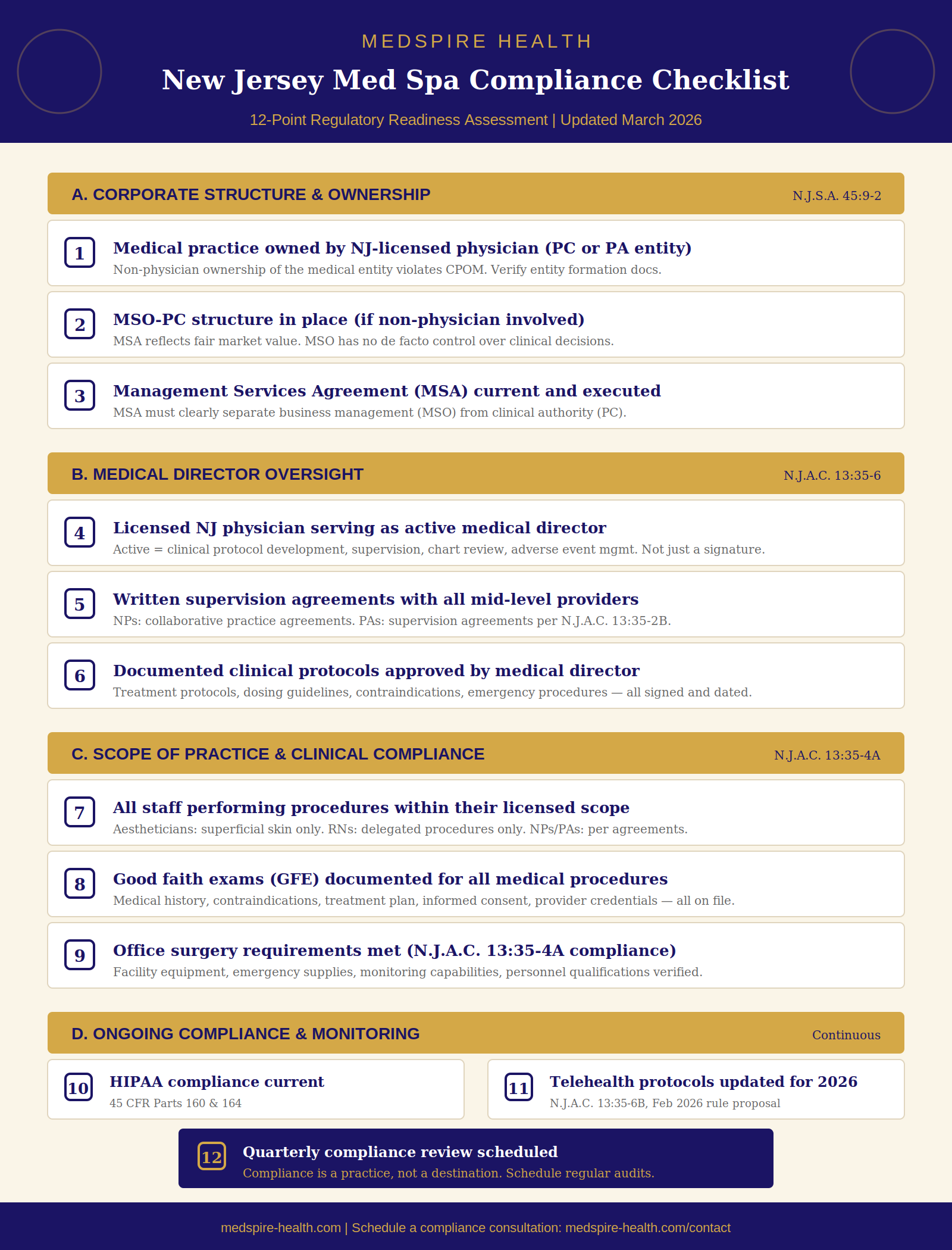
Enforcement and Penalties
New Jersey’s enforcement posture is not theoretical, and New York’s 2026 statewide enforcement sweep, which cited nearly 2 in 5 med spas for violations, shows how quickly regulators can move when they decide to act. The Board of Medical Examiners has the statutory authority to investigate complaints, conduct inspections, issue cease-and-desist orders, suspend or revoke medical licenses, impose civil penalties, and refer cases for criminal prosecution. They use it.
For med spa owners, the enforcement risk is not abstract. A single patient complaint. A disgruntled former employee. A competitor who files a tip. Any of these can trigger a Board investigation. And once the Board is looking, they do not limit themselves to the original complaint. They audit everything: your corporate structure, your medical director’s involvement, your staff’s credentials, your protocols, your documentation. If your practice is compliant, this is an inconvenience. If it is not, it is an existential threat.
The penalties for non-compliance in New Jersey include license suspension or revocation for the medical director, civil fines under the Board’s enforcement authority, criminal prosecution for unlicensed practice of medicine (N.J.S.A. 45:9-2), malpractice exposure for procedures performed outside scope, loss of insurance coverage, and forced closure of the practice.
I do not say this to scare you, I say it because the math is simple: the cost of compliance infrastructure is a fraction of the cost of a single enforcement action. And in New Jersey, the question is not whether enforcement happens – it is when it reaches your practice. Build the infrastructure now. Do not wait for the knock.
Frequently Asked Questions
Can a non-physician own a med spa in New Jersey?
No. New Jersey enforces the corporate practice of medicine (CPOM) doctrine, which prohibits non-physicians from owning medical practices. Because med spa treatments are classified as medical acts under N.J.S.A. 45:9-2, ownership must rest with a licensed physician. Non-physician entrepreneurs can participate through an MSO-PC (Management Services Organization – Professional Corporation) framework, where the physician retains clinical authority and ownership of the medical entity.
What can an aesthetician legally do in a New Jersey med spa?
In New Jersey, licensed aestheticians are restricted to superficial skin care services – facials, superficial exfoliation, non-medical-grade masks, and cosmetic application. They cannot perform injectables (Botox, fillers), medical-grade chemical peels, laser treatments, microneedling, or any procedure that penetrates beyond the epidermis. The New Jersey Board of Medical Examiners draws a hard regulatory line between cosmetology and medicine, and crossing it constitutes the unlicensed practice of medicine under N.J.S.A. 45:9-2.
Does New Jersey require a medical director for a med spa?
Yes. Any facility performing medical aesthetic procedures in New Jersey must operate under the direct oversight of a licensed physician who serves as medical director. The medical director must maintain active involvement in clinical protocols, staff supervision, and quality assurance. N.J.A.C. 13:35-6 and N.J.A.C. 13:35-4A define the physician’s supervisory obligations.
What changed about New Jersey med spa regulations in 2026?
In February 2026, the NJ Board of Medical Examiners and Board of Pharmacy published a joint rule proposal targeting prescription compounding, injectable administration, and telehealth prescribing oversight. The public comment period closes May 5, 2026. Additionally, N.J.A.C. 13:35 was readopted in January 2025 with updated provisions for telemedicine (Subchapter 6B) and PA telehealth practice (Subchapter 2C).
What are the penalties for med spa non-compliance in New Jersey?
Penalties include medical license suspension or revocation, civil fines, cease-and-desist orders, criminal prosecution for unlicensed practice, malpractice exposure, and forced closure. New Jersey’s Board of Medical Examiners has the authority to investigate complaints, conduct inspections, and refer cases for criminal prosecution. Enforcement has historically been aggressive, and the 2026 rule proposals signal further tightening.
Is Your New Jersey Med Spa Compliant?
The regulations are not getting simpler. The Board is not getting more lenient. And the operators who built their practices on “everyone’s doing it” are the ones who will be most exposed when enforcement catches up.
If you are operating a med spa in New Jersey – or planning to – and you are not certain your corporate structure, medical director arrangement, staff credentials, and clinical protocols meet current NJ requirements, that uncertainty is itself the problem. Compliance is not something you feel confident about. It is something you can demonstrate with documentation.
MedSpire Health works with med spa owners, wellness clinics, and telehealth organizations to build compliance infrastructure that is specific, documented, and defensible. Schedule a consultation to find out where you stand.
By Paula Kokko, Founder & CEO, MedSpire Health
This post is for informational purposes only and does not constitute legal advice. Consult with a qualified healthcare attorney for guidance specific to your practice.